
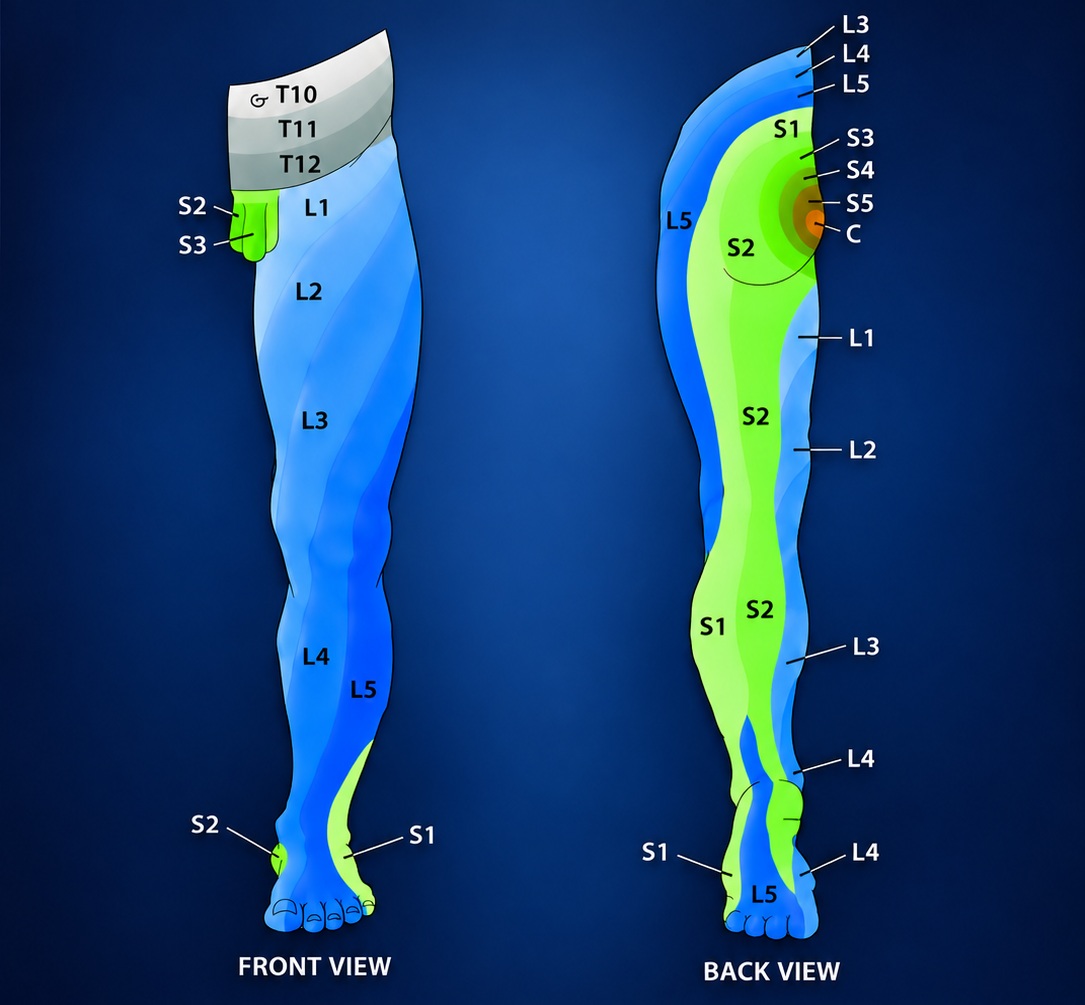
Lower Limb Dermatomes
|
The lower limb dermatomes represent the sensory territories supplied predominantly by the lumbar and sacral spinal nerve roots. These distributions extend from the lower back and buttock through the thigh and leg and into different areas of the foot. Irritation or compression of a lumbar or sacral nerve root can produce pain that travels beyond the lower back and into the leg. Patients may describe this as sciatica, shooting pain, burning, pins and needles, numbness or an electric sensation. The location of the symptoms can provide useful information about which nerve root may be involved. For example, symptoms may travel through the front of the thigh, along the inner or outer aspect of the leg, or towards the heel or foot depending on the affected nerve root. Common causes of lower-limb radicular pain include disc herniation, degenerative changes in the spine and narrowing of the spinal canal or neural foramina. A compressed or inflamed nerve root may cause both sensory symptoms and, in more significant cases, weakness or altered reflexes. However, pain in the leg does not automatically mean that a spinal nerve root is responsible. Hip disorders, peripheral nerve conditions, muscular problems and other causes can produce similar symptoms. A pain specialist will generally consider the patient’s symptom distribution together with neurological examination findings and, where appropriate, MRI or other investigations. This helps determine whether the symptoms are consistent with a particular nerve-root distribution and whether an interventional treatment may be appropriate. Clinical guidelines recognise epidural steroid injections as one possible treatment for selected patients with radicular pain; for example, transforaminal epidural steroid injection can provide short-term relief in some patients with lumbar disc herniation and radiculopathy. Depending on the cause and the individual patient’s circumstances, treatment may include medication, physiotherapy and rehabilitation, or targeted interventional procedures. These can include a Dorsal Root Ganglion Block, Dorsal Root Ganglion Pulsed Radiofrequency or Epidural Steroid Injection. A Dorsal Root Ganglion Block can help assess and treat pain arising from a particular nerve root, while Dorsal Root Ganglion Pulsed Radiofrequency uses controlled radiofrequency energy to modulate the function of the targeted sensory nerve structure. Epidural Steroid Injection aims to deliver anti-inflammatory medication into the epidural space around the affected spinal nerve roots. The choice between these approaches depends on the diagnosis, duration and severity of symptoms, examination findings, imaging and previous response to treatment. |
|